Just off 14 hours of labour- exhausted, excited, longing for some rest, hungry as heck – thats just your baby. Mama is emotionally and physically pretty much drained as well. So how do we do this feeding thing? This is your guide to navigating your hospital stay while breastfeeding your baby.
- Be prepared.
Long before you even start thinking about feeding, your breasts are already preparing for your baby. Come late first trimester and they’ve already begun to enlarge, the milk ducts and milk secreting cells developing. Your body will do all the work for you. The only thing one needs to watch out for are the contour of ones nipples. Some women have a ‘flat’ or ‘inverted’ nipple – both make it difficult for baby to latch properly. Ask your doctor to rule these out before delivery. These conditions are treated by easing the nipple out using negative pressure – a ‘nipple puller’ or a syringe with one end cut off will do the trick. Even a breast pump can help. You can start this antenatally, and continue doing it just before feeds when the baby arrives.
Forget birth partner, you need a breast feeding partner! No-one tells you that you might have an episiotomy, or even a caesarean. Both make holding your baby in those first few hours difficult. When Diya came, I needed someone to hold her to the breast every two hours, I couldn’t do it on my own. The hospital nurses were not always free to do this, so having someone with me who was experienced with holding babies (those wobbly necks!) was really helpful. I also couldn’t get out of bed to change her nappies, pick her up or comfort her. So find that superstar and recruit them before you get to hospital.
2. Sleepy baby!
Ali was born 4 weeks early. She just wouldn’t latch, wouldn’t feed, would do nothing but sleep! I was intent on exclusively breastfeeding her. Some of the methods the midwives tried were tickling her feet, and scratching her behind her ears, rather like you would do to a cat, all in the effort of waking her up. When she crossed the five hour mark without a feed, the head nurse put her foot down and gave her a little expressed milk via paladai (a tiny vessel with a long snout used for feeding babies). Premature babies might not have such a strong suckle reflex as a fully mature baby, and may need help feeding (More on feeding premature babies in an upcoming post).
Ali soon caught up, and was feeding like a champ in a few days. Theres no shame in resorting to paladai, sometimes even formula if the occasion absolutely calls for it. Remember, breast is best, but if it’s not happening despite your best efforts, ultimately a baby must be fed. Breastfeeding does not, and should not define you as a mother.
3. Making sure babys full and happy.
The problem with breast feeding is that it doesn’t give you a visual of the quantity of milk your baby is getting. So how do we make sure babys getting enough?
– Listen to your body. When your baby starts to suck, the combination of the suckling on the nipple and the affection that floods through you releases a hormone prolactin and milk starts to form. You will begin to feel a sensation – rather like pins and needles – in your breasts as they start to fill up. There will be a certain hardness to breasts when they are full, gradually softening as they empty.
-Make sure baby completely empties one breast before moving to the next. This takes about 5 – 10 minutes, but a newborn may suck on one breast for upto 20 minutes. The initial milk that is secreted, the fore-milk, is watery and only satisfies babys thirst. The hind-milk is full of the energy that baby needs to satisfy his/ her hunger, and making it imperative that baby empties Both breasts completely during each feed.
-Listen. You may be able to hear baby swallowing, this is a good sign that milk production is adequate.
-Your baby should put out enough urine. With cloth diapers, this entails 6 – 8 diapers per day, sometimes more. If you use store bought pampers, this entails at least 2 full, heavy nappies per day in the first 48 hours. By five days this should be at least 5 – 6 heavy, wet nappies per day. By the end of two weeks, baby poo should turn a mustard colour and there should be at least two episodes of poo per 24 hours. Breast fed babies actually poop more than formula fed babies, and this is normal. As long as the poop isnt too watery, and baby is putting out enough urine, there is no need to worry.
Side Note: Your baby may poop as soon as you start feeds. This is normal, and known as the ‘gastro- colic reflex.’ Gastro = stomach, colon = large intestine.
-Weight gain. Most babies actually lose weight (7 – 10% of birthweight) in the first few days. They regain their birth weight by 10 – 14 days and then steadily gain weight.
-Baby should be happy, sleepy and content after a feed. A baby that’s irritable, crying too much or not sleeping well might either not be getting enough milk, or may be colicky. Its best to consult your doctor to establish why.
4. The diet.
The hospital isn’t the best place to get a great diet. Breast milk may be a little slow to come to some women, taking a few days to really come in. How can you improve your flow?
Some patients, especially post caesarean may not be able to be on a full diet. Don’t worry, as this is usually only for one or two days, and very necessary for you to recover from such a major surgery. The doctor will sign off on your diet soon enough, and once you start eating well, the milk will begin to flow.
Hydrate, hydrate, hydrate. Drink fluids like you’ve been lost in the Sahara for the past 9 months. At least 3 litres of fluid per day, and if a good part of that can be milk, milkshakes, lassi, curd, yoghurt; even better.
Eat whatever you feel like eating. As long as it’s not raw, spicy, shellfish or prone to give you diarrhoea, just eat. Forget pregnancy cravings, breastfeeding cravings are a whole different ballgame. I just had a patient complain that her kin was too busy making sure she was eating healthy to tend to her cravings! As someone who had a friend bake an entire date-and-caramel cake, and then proceeded to Devour it on day 5 of my child’s birth, I completely sympathise.
*Disclaimer: Might not have been a great idea to devour an entire cake 5 days after giving birth!
More on a good, healthy (and yummy) breastfeeding diet in an upcoming post.
5. In Sickness and in Health
Sick Mamas, a doctor will usually not prescribe a medication to a new mother that cannot be taken during feeding. If you are on antibiotics for any reason, it is usually safe to continue feeding. There are a few special medications and illnesses that may require you to stop feeding, or express milk and feed your baby. Some of these include an attack of chicken pox just before/ during delivery, some types of tuberculosis, medications taken for some forms of psychiatric illnesses. The relationship with HIV and feeding is complicated. It is best to consult your doctor for individual concerns.
What about a sick baby?
My worst nightmare came true three days after Diya was born. Her poo seemed runny, I had been warned to expect that. But then it kept coming, getting more and more watery with each episode. When we checked, her temperature clocked in at 102 degrees F. We alerted the paediatrician, and he put her straight into the ICU, on IV antibiotics. Feeding her became my sole mission, I was there on the clock, every two hours. Thanks to a great NICU staff who coached and coaxed me through those days, Diya was able to avoid an IV drip. She came out 5 days later, on Christmas Day, well enough to go home.
Sick babies must be fed well, and fed often. The antibodies you give your baby through breast milk are priceless. Feeding every two hours goes a long way in preventing dehydration that might occur through treatments like phototherapy (a kind of light the baby is placed under to get rid of jaundice).
6. Of breast engorgement and cracked nipples.
Cracked, bleeding, painful nipples and swollen breasts? No wonder the Mughals had wet nurses!
If these things are happening to you, chances are the baby is not latching properly. The hospital is the best place to get this sorted. I always make sure I observe the mother feeding her baby first hand, the very best way to gauge if latching is correct. Theres only so much you can convey to your doctor via a conversation.
Still, some ways you can gauge for yourself are
- The entire areola is in the baby’s mouth, not just the nipple. The idea is the baby is using his/ her tongue to wind around the nipple and suck. If the baby is gumming you, it is going to hurt.
- The baby’s chin rests against your breast with his/ her nose free.
- Breastfeeding should not be painful. Some women experience pain during “let down” when the milk forms, but this should not last beyond a few seconds to a minute. If it continues to hurt, gently unlatch you baby and let them latch again. Continuing to breastfeed when it hurts causes fissures and cracks.
- The nipple should appear pink and erect after feeding. If white or misshapen, chances are your baby isn’t latching properly.
If you do begin to get a cracked nipple or fissure, the best medicine is breast milk. Just apply a little on the nipple after you’re done feeding. Breast engorgement takes you down the slippery and painful road to a breast abscess. Correct latching saves you the trip.
If you’re confident feeding and baby is well within her limits of weight loss (or gaining weight), then your hospital stay can come to a close, and we can sign off till next time.
Until then, here’s wishing you continued happiness and positivity on your journey.
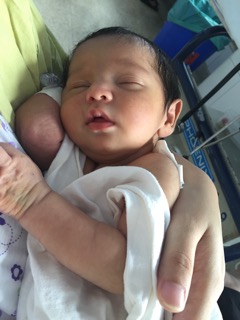
Heres a picture of Diya, our breast-fed Diva, rocking her IV-line while in the ICU, all of 5 days old.
The author is an Obstetrician -Gynaecologist practicing in Dr. Antonio Pinto do Rosario Hospital in Porvorim Goa, and a mother of two, who has had (at best) a rocky relationship with breastfeeding.
 For Women, For Health.